- Girlhood
- Posts
- Before Infertility, I Didn't Know Any of This 👇🏻
Before Infertility, I Didn't Know Any of This 👇🏻
Plus, The Magazine That Didn't Tell Us to Be Smaller Is Closing
Sponsored by

Hi friend, if you're new here, welcome to Girlhood — the group chat we should have had all along. This week, we're mourning the closing of a magazine that taught a generation of women to take up space, sitting with eight years of infertility, getting into why eight weeks of leave is not a benefit package, and having the chin hair conversation nobody warned us about. Grab a beverage and settle in.
📰 SELF Magazine Is Closing, and I'm Not Over It
When I was maybe ten or eleven, before I knew I could write, I was convinced I was going to be a fashion designer. Or a makeup artist. The plan changed weekly. What didn't change was the ritual: cutting up magazine covers, doing my own makeup on the models with whatever drugstore eyeshadow I could get my hands on, and plastering them across my bedroom walls like I was curating something. SELF was always in that pile.
I found out last week that it's closing after 47 years, and I am genuinely sad.
Here's what I'm not sure anyone is saying: SELF wasn't just a health magazine. Growing up, surrounded by Allure and Glamour and Cosmo and Teen Vogue (RIP to another legend) — all those glossy, aspirational universes telling us to be smaller and prettier and more palatable — SELF was always just there. Telling us to get stronger, to understand what was happening in our own bodies, to actually show up for our own care. It was a different message. And for a lot of us, it helped quietly undo what we'd been absorbing for years, which was, mostly, that our bodies were problems to manage.

As someone who once dreamed of working within the walls of Condé Nast, this stings. As a founder who has spent years trying to do something similar — make women's health feel less confusing, less clinical, more like something that actually belongs to you — it feels like a small defeat.
Every outlet that takes women's health seriously makes that work a little more possible. Every one that closes makes it a little lonelier, and a little more urgent.
🔍 Ask Clara: What are the best podcasts for women in their 30s?
💌 Can’t find Girlhood in your inbox?
Check Spam or Promotions, drag us back, then add [[email protected]] to your contacts and ⭐ it, so we always land right where we belong.
🌸 National Infertility Awareness Week: Three Kids, Eight Years, and a Lot of Feelings
It's NIAW, which means I've been thinking a lot about the version of me who sat in a fertility clinic waiting room at 28 — college-educated, completely blindsided — and learned for the first time that you actually have to ovulate to get pregnant. I wish that were a joke. It is not even a little bit a joke.
That appointment eventually led to a PCOS diagnosis, a string of failed IUIs, and a path to IVF that took longer and hurt more than I'd let myself imagine. My twins arrived after all of it, but a high-risk pregnancy made sure I never quite exhaled: at 27 weeks, my cervix shortened overnight, and what had been a regular Tuesday turned into hospital bed rest and breath I held for weeks.
My third was a different kind of hard: two miscarriages, several failed transfers, and one last cycle where we'd already talked through what "done" would look like if it didn't work. He just turned sixteen months, which still feels a little impossible to say out loud.

I share all of this because 1 in 6 people will experience infertility in their lifetime, and most of them will do it in waiting rooms and two-week waits and late-night searches that never quite say the thing they actually need to hear. The information exists, but the community, the language, the permission to fall apart and still keep going? That part is harder to find.
That's the whole reason Rescripted exists, and my inbox is always open.
📬 Your friend’s cool for forwarding this, but don’t wait — subscribe to Girlhood, and get the real talk delivered straight to your inbox first. And for conversations that happen in the moment, join our WhatsApp community to connect with other women who get it.
✨ The Chin Hair Conversation I Didn't Know I Needed
This week, mid-facial, my esthetician asked if she could pluck my chin hairs. I said yes, obviously, and then we started talking about all of the things we have to do to maintain our appearance as women, which naturally led to hair loss, and she — who is Irish, which makes everything she says land harder — looked at me completely deadpan and said, "They're losing it on their head and gaining it on their chin."
I've never felt so seen in my life.

Because if you have PCOS, you know. The acne that shows up on your jaw like it's paying rent. The three hairs you find on your chin on a Tuesday for no reason. The question you're always running in the background: is this my pillowcase, my towels, my workout, or the hormonal disorder I'll be managing for the rest of my adult life?
Here's the short version of what's actually happening: PCOS drives up androgens (testosterone and related hormones), which can shrink hair follicles on your scalp while simultaneously encouraging them everywhere else. It's not random or your skincare routine; it's your endocrine system doing its thing, loudly, on your face.
I don't want to go back on birth control, I'm not ready to commit to spironolactone, and I've mostly made my peace with the fact that I will probably be plucking in the car for the foreseeable future — but I'm also starting to think laser hair removal wouldn't hurt.
When buying something for yourself (like skincare, fitness, or wellness), how much does price influence your decision?Everyone approaches spending a little differently — help us understand what influences yours! |
😤 Eight Weeks Is Not Enough (And Deloitte Knows It)
Speaking of things our bodies go through that nobody plans for…
When I had my twins, my company gave me four and a half months of paid maternity leave, and I was so grateful I could have cried — which, given that I was postpartum and running on fumes, I probably did. Twin A came vaginally, Twin B was an emergency C-section, I hemorrhaged, and my mental health took a hit I wasn't prepared for. At eight weeks, when I was barely cleared for sex and exercise, the idea of returning to work full-time would have broken me. That leave wasn't a perk; it was the thing that kept me upright.
So when I saw that Deloitte is cutting paid parental leave in half — from 16 weeks to 8 for a segment of its workforce, alongside a $50,000 IVF reimbursement and days of PTO — my stomach dropped, not because I was surprised, but because I know what eight weeks postpartum actually looks like from the inside.
The part that should concern everyone: a former Google head of HR said this move "legitimizes the action for everybody else," meaning Deloitte isn't the ending of this story; it's the opening.

We talk constantly about what women need to show up fully — at home, at work, in their own bodies — and then watch companies quietly pull the rug out and call it a business decision. Eight weeks is not enough to recover from a birth, barely enough to figure out breastfeeding, and certainly not enough to return to a job that requires your full brain. I was one of the lucky ones.
xo,
Kristyn
P.S. If you want to do something with all of this, Resolve's Month of Action is a good place to start: real advocacy, real policy change, around the issues that affect every family-building story in this newsletter. Get involved here.
Finally, Skincare That Boosts NAD+ At the Source
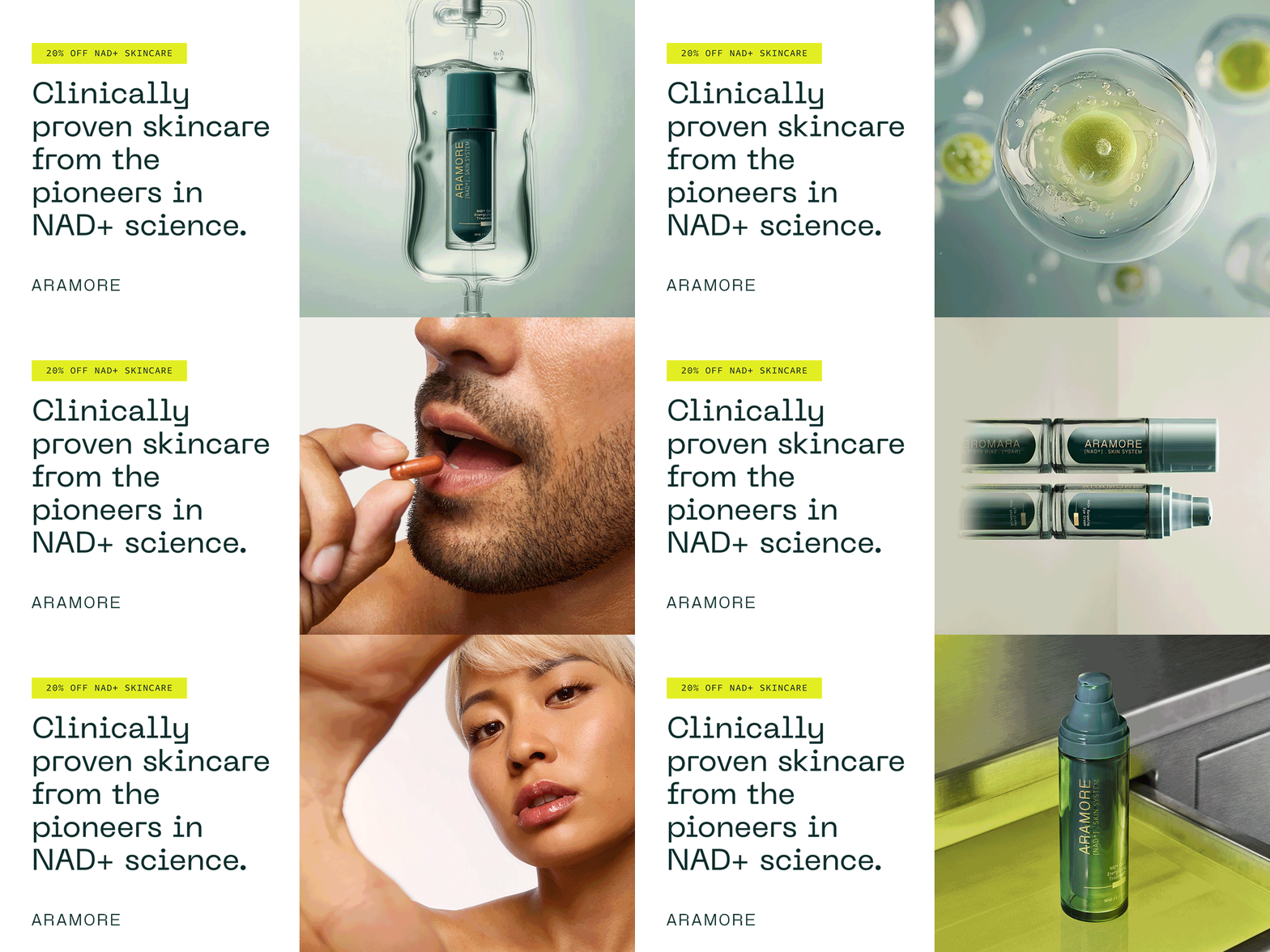
For decades, skincare has focused on aesthetic results. But we started by asking a different question: what if instead of trying to preserve our skin's youth, we prioritized optimizing our skin's function? That's how Aramore’s NAD+ skincare was born.
Developed by Harvard & MIT scientists, Aramore is a skincare system based on skin’s performance, not just its appearance. NAD+ production slows down significantly as we age, and this causes all the telltale science of aging.
Aramore is the only skincare formulated to help skin produce NAD+ like much younger skin would. The result? Skin that’s stronger, firmer, and more resilient, that not only looks better, but stays healthier over time.
Reply