- Girlhood
- Posts
- What Bridgerton Gets So Right About Female Pleasure 👑
What Bridgerton Gets So Right About Female Pleasure 👑
Plus: The Part of Motherhood After Infertility No One Talks About
If you’re new here, welcome to Girlhood: the group chat we should have had all along, where we talk openly about our bodies, the questions we whisper about, and the everyday moments that make us pause, laugh, or rethink life. This week, we’re noticing the subtle ways our bodies ask for attention — and what changes when we finally listen. Let’s dive in!
Hi friend,
Let me start by saying: I am not, and never have been, a haircare girly.
I didn’t grow up knowing the difference between a mask and a conditioner. I’ve never instinctively understood which shampoo was “obviously” right for my hair type. I’ve always kind of assumed that haircare was one of those skills you either picked up early — or quietly accepted you’d never fully grasp.
For most of my adult life, my hair routine looked like this: wash when it felt gross, condition (because you’re supposed to), heat-style if I was feeling virtuous, air dry if I wasn’t. If my scalp flaked, I panicked. If my hair felt dry, I bought something heavier. If it felt greasy, I solved the problem with… a lot of dry shampoo.
Then I started watching Abbey Yung on TikTok, and for the first time ever, haircare started feeling less like a chore and more like a system.
What people on social media refer to as “The Abbey Yung Method” isn’t an official program or a rigid routine. It’s more of a framework: a way of understanding hair that cuts through a lot of the noise, marketing, and frankly, nonsense that dominates haircare advice online.
If you’re starting a haircare journey and don’t identify as someone who’s “good at this stuff,” here’s everything you need to know. You can thank me later.

🔍 Ask Clara: What else should I know about hair and scalp health?
💌 Can’t find Girlhood in your inbox?
Check Spam or Promotions, drag us back, then add [[email protected]] to your contacts and ⭐ it, so we always land right where we belong.
🥦 Is Fiber the New Protein?
Speaking of “trends,” if 2025 was peak protein, I was fully on board. I tracked it, prioritized it, and mentally calculated grams while ordering lunch. For a while, it felt empowering, like we were finally done with the “eat less” messaging and stepping into something stronger. That era mattered. Muscle, bones, metabolism: it all still matters.
But lately, the conversations I keep having with friends sound different. They’re less about hitting 100 grams and more about why we’re bloated, crashing at 3 p.m., or thinking about sugar even when we technically “did everything right.” And more often than not, the missing piece isn’t protein. It’s fiber.
Most women need around 25 to 30 grams a day, and many of us aren’t even close. Fiber supports blood sugar balance, digestion, cholesterol, and estrogen metabolism (which becomes especially relevant in our 30s and 40s when hormones start doing their own unpredictable dance — hi, perimenopause). It’s not glamorous. No one is bragging about their chia seeds. But it is foundational.
When I started paying attention, I realized I was building meals around protein and treating plants like an afterthought. So I began adding flax to smoothies, berries to breakfast, and vegetables to basically everything. Nothing extreme. Nothing restrictive. Just more color. More variety.
In hindsight, I think I’d been chasing optimization when what my body really needed was consistency.
What I noticed wasn’t dramatic, but it was meaningful: steadier energy, fewer intense cravings, more regular digestion — the kind of subtle shifts that make a long week feel a little more manageable.
This isn’t about abandoning protein or chasing another wellness headline. It’s about supporting our bodies in ways that feel sustainable and grounded, the kind of care that doesn’t need to “trend” to be worth it.
If you’ve been feeling off, take a look at your plate this week. Not to critique it, just to notice. Sometimes caring for ourselves starts with something as simple as adding one more plant.
🔍 Ask Clara: What are some high-fiber foods to add to your diet?
📬 Your friend’s cool for forwarding this, but don’t wait — subscribe to Girlhood, and get the real talk delivered straight to your inbox first. And for conversations that happen in the moment, join our WhatsApp community to connect with other women who get it.
❄️ Are We Done or Just… Tired?
People don’t talk enough about how hard it is to know you’re “done” having kids after years of infertility. Mostly because “done” implies a level of certainty that infertility never really gives you.
For some of my friends, done was a feeling. A conversation that landed. A vasectomy scheduled. Boom, chapter closed. Their families felt complete in a calm, decisive way that I still find a little impressive.
For me, it’s blurrier.
My husband and I still pay for embryo storage, which means the question never fully goes away; it just kind of lingers in the background of our lives. Every month, that charge hits my card and gently reminds me that the possibility is still there, quite literally frozen and waiting, even if I’m not totally sure what I want to do with it.

It’s not that I don’t love the life we have — I really do. But in another universe, one where groceries were cheaper, and someone reliably cooked us dinner every night, I could absolutely imagine a fourth kid fitting right in. In this universe, I mostly imagine needing a nap. And maybe a personal assistant.
What I’m realizing is that after infertility, certainty is hard to trust. You get so used to living in the “maybe,” holding multiple futures in your head at once, that it becomes your default setting. Embryo storage just keeps that muscle strong.
Maybe being done doesn’t come with a clear, confident moment. Maybe it’s just noticing you don’t feel the same urgency anymore. Or that the ache is quieter than it used to be. And still, if I’m being honest, there’s a small part of me that hesitates every time that storage bill hits. Like… are we sure?
🔍 Ask Clara: What is embryo donation?
💸 If you’ve ever thought, “Why doesn’t women’s health work better than this?” — this is your chance to shape it (and yes, you’ll be paid). 💸
We’re building a team of women whose experiences, attitudes, perceptions, wants, and needs will help drive innovation across the women’s health & wellness industries.
👉 Join our team here.
From there, we’ll reach out with paid opportunities that align with your background and interests.
Thank you for being here and for lending your voice to help improve the journey for women everywhere. 💜
👑 What Bridgerton Gets So Right About Female Pleasure
I did not have “Bridgerton teaches us about the pleasure gap” on my 2026 bingo card, and yet… here we are.
Just when we’d all quietly filed Francesca away as the soft-spoken, piano-playing sister, season 4 gently (and brilliantly) flipped the script. The Pinnacle storyline doesn’t rely on scandal or smolder. It slows down, turns inward, and asks a far more interesting question than “Will this romance work?” It asks whether she’s actually fulfilled.
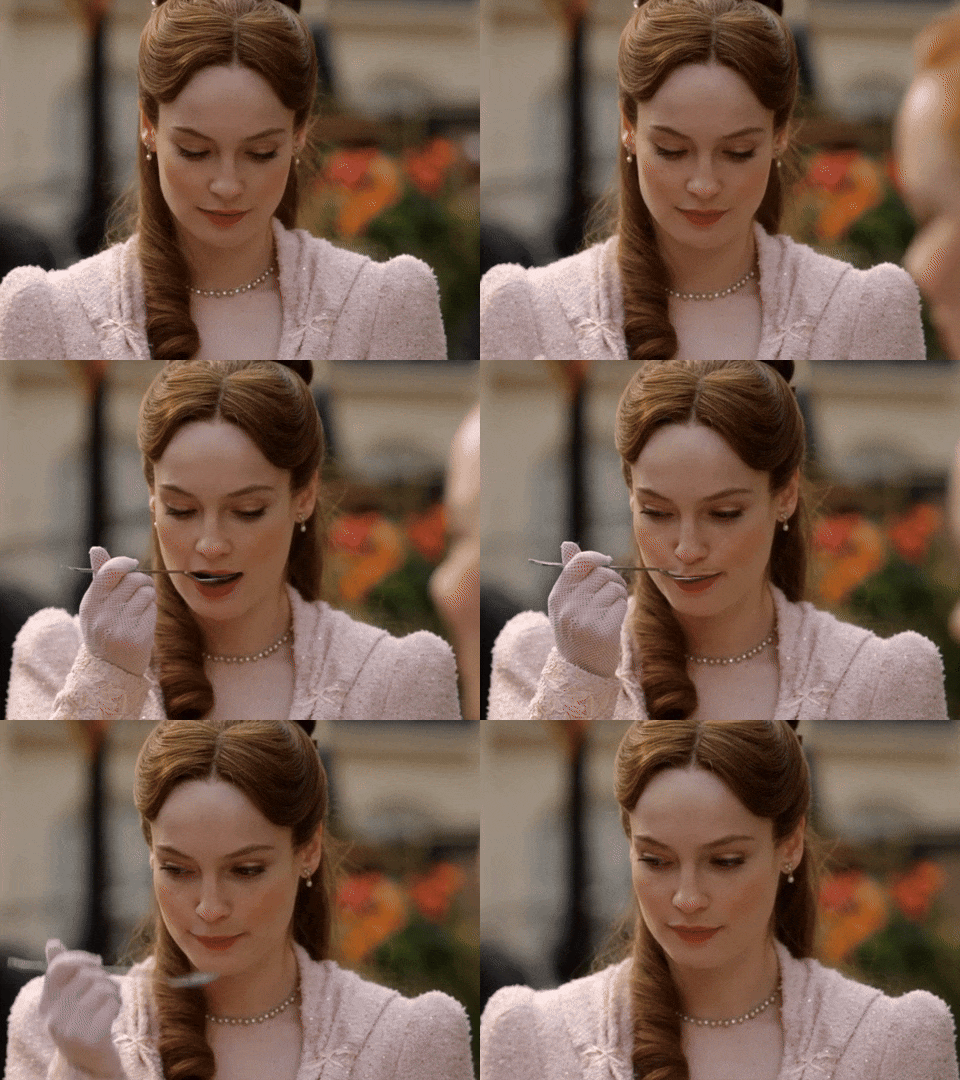
There’s a moment when Francesca asks her mother what a “pinnacle” even is, and it’s tender and awkward in a way that feels almost too real, because how many of us were taught how to be desirable long before we were taught how our own bodies work?
What feels radical about her arc isn’t the steaminess; it’s the attentiveness. Intimacy unfolds with her, not to her. She’s allowed to not know, to ask questions, to figure it out in real time.
And that’s the part that lingers for me, especially in a culture where female desire has so often been framed as reactive or performative, something we measure by whether everyone else is satisfied. But for many women, desire builds with safety and emotional connection, which isn’t prudish; it’s physiology. When we understand our anatomy and communicate what actually feels good, intimacy shifts. It becomes less about performance and more about presence.
Francesca doesn’t suddenly become louder; she becomes more attuned to herself, and somehow, in 2026, that still feels groundbreaking.
If a Regency-era drama can help normalize curiosity, communication, and centering our own pleasure, I’m all in. Read the full breakdown here.
xo,
Kristyn
🔍 Ask Clara: What is the gender pleasure gap?
Quick vibe check on today's issue 👇🏻 |


Reply